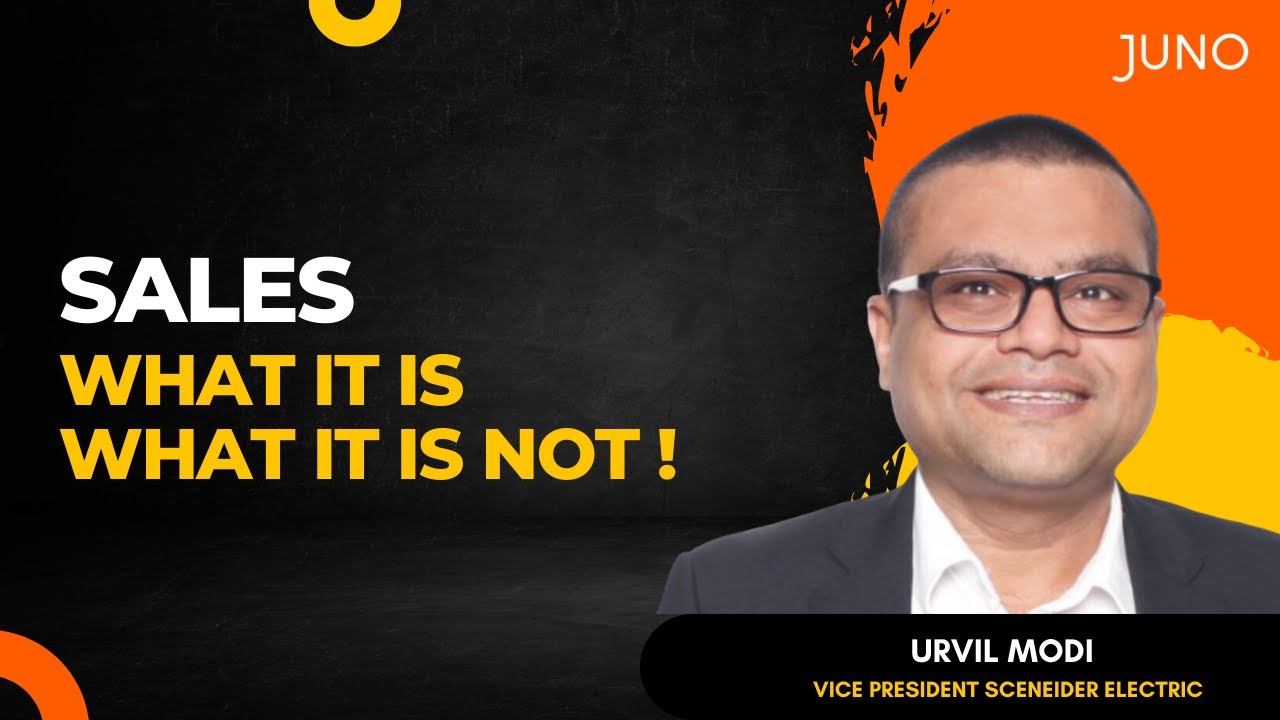
Urvil Modi, a visionary sales strategist, challenges the traditional notion that sales is merely about closing deals. He posits that the true essence of effective sales lies in becoming an adept problem-solver and a master of persuasion, guiding clients to discover and embrace solutions that genuinely address their underlying challenges. This profound shift in perspective empowers professionals to build stronger relationships and achieve sustainable growth.
The customer is not here to give you business, that's our job, that's what we want to do. The customer is sitting across the table with us because he has a problem that he wants to solve.
At its heart, sales is not about simply pushing a product or service onto a customer. Instead, its true purpose lies in identifying and effectively solving a customer's underlying problem. Customers don't approach you just to buy something; they engage because they have a need, a challenge, or an aspiration they want to address.
Consider the example of purchasing a car. The customer isn't primarily focused on the brand, like a Maruti or Hyundai. Their focus is on solving a specific problem: daily commuting, providing family transport for weekend outings, or perhaps achieving a certain social status. A skilled salesperson understands this and aligns their car offering with these deeper, personal needs rather than just listing features.
There's a critical distinction between mere persistence and true persuasion in sales. Persistence can often be a "mistaken action for achievement," where continuous, relentless effort doesn't necessarily lead to results. True persuasion, however, involves strategically convincing the customer *why* your product or service is the ideal solution for *their* specific problem.
An example of this is the "mafa syndrome" – mistaken actions for achievement. This describes a scenario where salespeople might constantly follow up or push without genuinely understanding the customer's 'why.' Such actions feel productive but ultimately fail to resonate or close a deal. Effective persuasion means understanding the customer's motivation and speaking directly to it.
One of the most common pitfalls in sales is to lead with price, discounts, or even freebies. While these can seem appealing, customers, especially in value-conscious markets like India, are fundamentally seeking 'value for money.' The key is to clearly demonstrate how your offering provides significantly more benefit and solves problems far beyond its sticker price.
For instance, if you can convince a customer that your solution will generate "a value worth a million rupees a year" for their business, the specific price you quote becomes a much smaller consideration. They are no longer evaluating a cost, but calculating a substantial return on investment. This shifts the conversation from a commodity transaction to a strategic partnership.
Building unwavering trust is the bedrock of long-term sales success. Avoid common strategies that erode trust, such as over-promising and then failing to deliver. Even the tactic of consistently under-promising to 'over-deliver' can be problematic, as it suggests a lack of transparency.
Instead, the most powerful approach is to consistently stick to your word and deliver exactly what you promised. The expert identifies three types of brands: those who over-promise and inevitably disappoint, those who under-promise to always have a 'back pocket' offer, and those who simply deliver what they commit to. It is this third type that builds the strongest, most authentic customer trust and loyalty.
It's time to shift away from the traditional marketing 4 Ps (Product, Price, Place, Promotion) and embrace a sales-centric framework. An effective sales approach prioritizes a different set of Ps: Problem, People (the decision-makers), Persuasion, and only then, Product. Your product's features and benefits are only relevant once you've understood the first three.
The expert explicitly outlines these "four Ps of sales" as "problem, people, persuasion, and then product." This emphasizes that a customer's engagement always begins with a problem they need to solve. By understanding their problem, identifying the right people to influence, and persuasively linking your solution, the product naturally becomes the answer.
Exceptional service, delivered with genuine care and precision, can be a powerful differentiator, regardless of the transaction size. Avoid being pushy or overly insistent; instead, prioritize understanding and respecting customer needs and boundaries. High-quality, attentive service, even if it comes at a higher price point, is what fosters deep customer loyalty.
The expert illustrates this with a comparison of two hairdressers: 'Auntie' was pushy, clingy, and tried to upsell, while 'May' performed the same simple haircut with immense care and precision, never pushing unwanted services. Despite May being more expensive, her genuine care and respect for the customer's needs earned the expert's unwavering loyalty. This principle applies across all sales contexts.
Customers engage with you because they have an underlying need or problem they want to address, not simply to buy your offering. Your product or service is merely the vehicle through which that solution is delivered.
Simply taking continuous action or repeatedly contacting a customer without understanding their needs and persuasively demonstrating how your solution addresses them is ineffective. Persuasion focuses on the customer's 'why,' making every interaction meaningful.
Customers assess the overall value they receive in exchange for their money. If you can clearly articulate how your product or service provides significant benefits and solves critical problems, the perceived value will outweigh the price, making cost a secondary consideration.
"What specific challenge or bottleneck are you currently facing that prompted you to seek a solution like ours?"
PURPOSE: Identify the core problem."How does this problem impact your team's productivity, your operational costs, or your strategic goals?"
PURPOSE: Quantify the pain and value."What have you tried in the past to address this, and what were the outcomes?"
PURPOSE: Understand previous attempts and failures."Who are the key stakeholders involved in making decisions for this type of solution, and what are their primary concerns?"
PURPOSE: Map out "People" and their perspectives."If we could effectively solve this problem for you, what would that success look like in terms of measurable results?"
PURPOSE: Define desired outcomes and articulate value."Beyond the immediate solution, what long-term value are you hoping to gain from a partnership with a provider?"
PURPOSE: Uncover strategic value and trust potential.Shift your mindset from selling to diagnosing. Focus intensely on uncovering customer problems before ever presenting a solution. This approach builds rapport and positions you as a trusted advisor, not just a vendor.
Before building, validate the problem your product solves. Ensure you understand the depth of the customer's pain point and the value your solution truly brings, making your offering indispensable.
Craft your messaging around the problems your audience faces and how your product provides the most effective solution. Highlight the value and transformation, rather than just listing product attributes.
Develop your ability to actively listen and understand underlying needs. This foundational skill is crucial for any client-facing role, enabling you to connect deeply and offer meaningful contributions.
Your approach has to start probably from problem first, people, persuasion, and then product.
Join thousands of Indian professionals learning from industry experts.
Explore All Courses →